*if you are unable to access an article, please email me for a PDF copy
Peer-Reviewed Journal Articles:
2026
34. Kubasta, K, Vanderwolf KJ, Tourangeau S, Urquhart O, & CE Markle. Accepted. First assessment of skin pH of Blanding’s and spotted turtles. Herpetological Conservation and Biology.
33. Steblaj V, Van Huizen B, Sherwood E, Waddington JM, & CE Markle. 2026. A comparison of spatial interpolation approaches for mapping habitat and peatland ecohydrological metrics. Wetlands 46:99.
32. Piczak ML, Sergio AJA, Brown CR, Birch WS, Flitcroft RL, Krawchuk MA, McCarter CPR, Moore JW, Murphy BP, Penaluna BE, Rupasinghe PA, Steblaj V, Wilkinson SL, & CE Markle. 2026. The integration of fire ecology and freshwater ecosystems in North America: Knowledge gaps and research needs. Global Change Biology 32(6): 1-27. Open access.
31. Moore M, Kanne AI, Markle CE, Smolarz AG, Moore PA, Furukawa AK, & JM Waddington. 2026. Depression storage control moss and lichen moisture availability and net primary productivity in rock barrens turtle nesting habitat. Ecohydrology 19(1):e70190. Open access.
30. Fallas RY, Markle CE, Moore PA, & JM Waddington. 2026. Micrometeorological variability and climate change affect snake overwintering habitat resilience. Climate Change Ecology 11:100108. Open access.
2025
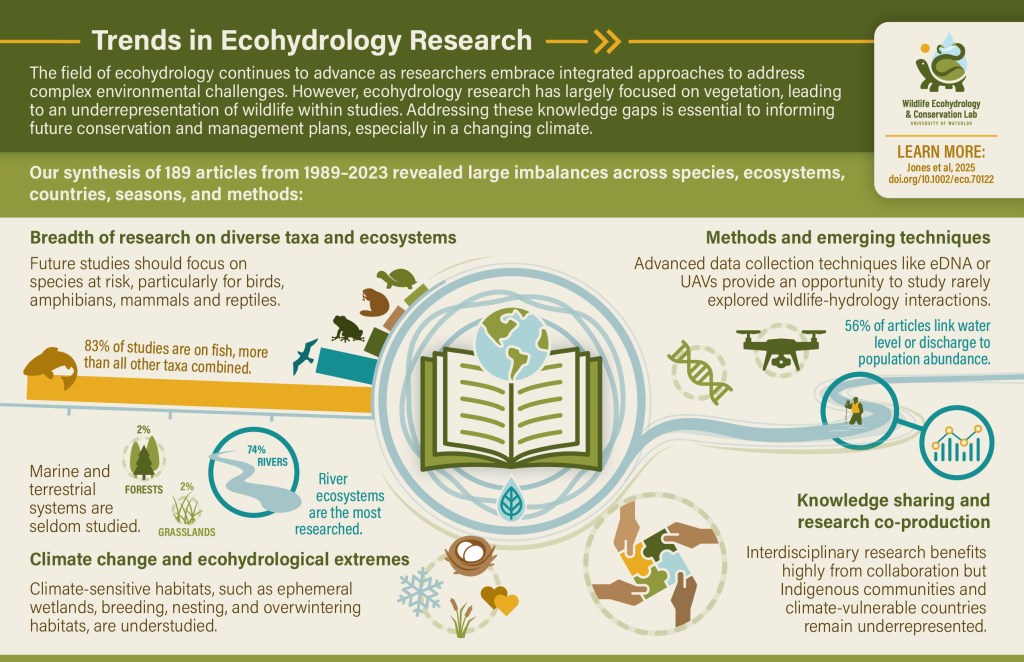
29. Jones M, Steblaj V, Schang K, Ross M, & CE Markle. 2025. Water, wildlife, and the world: A global synthesis of trends in wildlife ecohydrology research. Ecohydrology 18(7):e70122. Open access.
28. Tekatch A, Markle CE, Wilkinson SL, McCarter CPR, Moore PA, & JM Waddington. 2025. Ecohydrological drivers of boreal shield peatland fire refugia. Ecohydrology 18(5):e70075.
27. McManus K, Standen K, Lyons C, Markle CE, Baltzer J. 2025. Limitations of a frozen feast: Light availability affects boreal plant access to novel nitrogen released from permafrost thaw. Ecosystems 29(8).
2024
26. North T, Markle CE, Fallas RY, Moore PA & JM Waddington. 2024. Initial impacts of wildfire on overwintering conditions for a species-at-risk snake. Global Ecology and Conservation. doi:10.1016/j.gecco.2024.e03258. Open access.
25. Van Huizen B, Markle CE, Moore PA, & JM Waddington. 2024. Bedrock morphology influences rock barrens turtle nesting habitat energy dynamics. Ecology and Evolution. doi:10.1002/ece3.11183. Open Access.
24. Markle CE, Simone KL, Wilkinson SL, Freeman HCA, Wiebe S, Sherwood E, & JM Waddington. 2024. Severe wildfire affects thermal and moisture regimes of at-risk turtle nesting habitat. Northeastern Naturalist, Emydine Special Issue. Open Access.
23. Markle CE, Freeman H, Hudson D, Waddington JM. 2024. Creating landscape-appropriate habitat restoration strategies: Success of a novel nesting habitat design for imperiled freshwater turtles in rock barren landscapes. Restoration Ecology. Open Access. Nest habitat creation guide.
2023
22. North TD, Moore PA, Birch WS, Markle CE, Freeman HCA, Furukawa AK, Hudson DT, Wilkinson SL, & JM Waddington. 2023. iWetland: A community science platform for monitoring wetland water levels. Citizen Science: Theory and Practice 8(1):1-15.
2022
21. Markle CE, Gage HJM, Tekatch AM, Wilkinson SL, & JM Waddington. 2022. Wetland successional state affects fire severity in a boreal shield landscape. Wetlands 42:87. Link to paper.
2021
20. Markle CE, Law T, Freeman HCA, Caverhill B, Davy CM, Hathaway J, McNeil J, Moxley KJ, Richer S & P Chow-Fraser. 2021. Using the Blanding’s turtle (Emydoidea blandingii) plastron as a ‘fingerprint’: Photo identification of an endangered species. Canadian Wildlife Biology and Management. Open Access link to paper.
19. Markle CE, Sandler NA, Freeman HC, & JM Waddington. 2021. Multi-scale assessment of rock barrens turtle nesting habitat: Effects of moisture and temperature on hatch success. Ichthyology and Herpetology 109: 507-521. doi: 10.1643/h2020125. Open Access link to paper.
2020
18. Hudson DT, Markle CE, Harris LI, Moore PA, & JM Waddington. 2020. Ecohydrological controls on lichen and moss CO2 exchange in rock barrens turtle nesting habitat. Ecohydrology. doi: 10.1002/eco/2255. Open Access link to paper.
17. Markle CE, North TD, Harris LI, Moore PA, & JM Waddington. 2020. Spatial heterogeneity of surface topography in peatlands: assessing overwintering habitat availability for the eastern massasauga rattlesnake. Wetlands 40(6): 2337-2349. doi: 10.1007/s13157-020-01378-2. Link to paper.
16. Wilkinson S, Tekatch A, Markle CE, Moore PA, & JM Waddington. 2020. Shallow peat is most vulnerable to high peat burn severity during wildfire. Environmental Research Letters. doi: 10.1088/1748-9326/aba7e8. Link to paper.
15. Markle CE, Wilkinson SL & JM Waddington. 2020. Initial effects of wildfire on freshwater turtle nesting habitat. Journal of Wildlife Management. doi: 10.1002/jwmg.21921. Link to paper.
14. Markle CE, Moore PA, & JM Waddington. 2020. Primary drivers of reptile overwintering habitat suitability: Integrating wetland ecohydrology and spatial complexity. BioScience. doi: 10.1093.biosci/biaa059. Link to paper.
13. Markle CE, Moore PA, & JM Waddington. 2020. Temporal variability of overwintering conditions for a species-at-risk snake: Implications for climate change and habitat management. Global Ecology and Conservation. 22: e00923. Open Access link to paper.
2019
12. Paterson JE, Baxter-Gilbert J, Beaudry F, Carstairs S, Chow-Fraser P, Edge CB, Lentini AM, Litzgus JD, Markle CE, McKeown K, Moore JA, Refsnider JM, Riley JL, Rouse JD, Seburn DC, Zimmerling JR, & CM Davy. 2019. Road avoidance and its energetic consequences for reptiles. Ecology and Evolution. 2019; 00:1-10. https://doi.org/10.1002/ece3.5515. PDF
11. Piczak M, Markle CE, & P Chow-Fraser. 2019. Decades of road mortality cause severe decline in a common snapping turtle population. Chelonian Conservation and Biology 18(2):231-240. https://doi.org/10.2744/CCB-1345.1. Link to paper.
10. Moore PA, Smolarz AG, Markle CE, & JM Waddington. 2019. Hydrological and thermal properties of moss and lichen species on rock barrens: Implications for turtle nesting habitat. Ecohydrology 12(2):e2057. doi:10.1002/eco.2057. Link to paper.
2018
9. Markle CE, Rutledge JM, & P Chow-Fraser. 2018. Factors affecting coastal wetland occupancy for Eastern Musk Turtles (Sternotherus odoratus) in Georgian Bay, Lake Huron. Herpetologica 74 (3): 236-244. PDF
8. Smolarz AG, Moore PA, Markle CE, & JM Waddington. 2018. Identifying resilient eastern massasauga rattlesnake (Sistrurus catenatus) peatland hummock hibernacula. Canadian Journal of Zoology 96 (9): 1024-1031. doi 10.1139/cjz-2017-0334. Link to paper
7. Markle CE & P Chow-Fraser. 2018. Effects of European Common Reed on Blanding’s Turtle Spatial Ecology. Journal of Wildlife Management. doi 10.1002/jwmg.21 435 PDF
6. Markle CE, Chow-Fraser GE, & P Chow-Fraser. 2018. Long-term habitat changes in a protected area: Implications for herpetofauna habitat management and restoration. PLoS One 13(2):e0192134. PDF Supplementary: Table S1
2017
5. Markle CE, Gillingwater, SD, Levick R, & P Chow-Fraser. 2017. The true cost of partial fencing: Evaluating strategies to reduce reptile road mortality. Wildlife Society Bulletin 41(2):342–350. PDF Supplementary: Tables S1-S5
4. Markle CE & P Chow-Fraser. 2017. Thermal characteristics of overwintering sites for the Blanding’s turtle (Emydoidea blandingii) across three study areas in Ontario, Canada. Herpetological Conservation and Biology 12:241–251. Open Access link to paper.
2016
3. Markle CE & P Chow-Fraser. 2016. An integrative approach to regional mapping of suitable habitat for the Blanding’s turtle (Emydoidea blandingii) on islands in Georgian Bay, Lake Huron. Global Ecology and Conservation. 6(2016): 219–231. PDF
2. Marcaccio JV, Markle CE, & P Chow-Fraser. 2016. Use of fixed-wing and multi-rotor unmanned aerial vehicles to map dynamic changes in a freshwater marsh. Journal of Unmanned Vehicle Systems. 4(3): 193–202. PDF
2014
1. Markle CE & P Chow-Fraser. 2014. Habitat selection by the Blanding’s turtle (Emydoidea blandingii) on a protected island in Georgian Bay, Lake Huron. Chelonian Conservation and Biology. 13(2): 216–226. Link to paper.
Peer-Reviewed Proceedings:
- Marcaccio JV, Markle CE, & P Chow-Fraser. 2015. Unmanned aerial vehicles produce high-resolution, seasonally-relevant imagery for classifying wetland vegetation. The International Archives of the Photogrammetry, Remote Sensing and Spatial Information Sciences, Volume XL-1/W4, 2015, International Conference on Unmanned Aerial Vehicles in Geomatics, 30 Aug – 02 Sep 2015, Toronto, Canada, pages 249–256. doi: 10.5194/isprsarchives-XL-1-W4-249-2015. (peer-reviewed).
Book Chapters:
2. Gillingwater SD, Levick R, & CE Markle. 2024. “On the road to recovery: Saving Long Point’s species at risk”. Pages 306-314 In SC Walls & KM O’Donnell (Eds.), Strategies for Conservation Success in Herpetology. Society for the Study of Amphibians and Reptiles, University Heights, OH, USA.
1. Markle CE & P Chow-Fraser. 2017. “Georgian Bay, Lake Huron: Freshwater turtles and their wetland habitat in a changing landscape”. In E. Freedman & M. Neuzil (Eds.), Biodiversity, Conservation, and Environmental Management in the Great Lakes Basin. New York, USA: Routledge.

